
AI Regulation and AI Labeling Requirements, Part II: Texts and AI Interactions
The labelling requirements under the European AI Regulation have been in force since August 2026. In Part II of our series of articles on this topic, we explain what this means for AI-generated texts and direct user interactions.
Disclaimer: The information provided on this website does not constitute legal advice and is not intended to address any legal issues or problems that may arise in individual cases. The information on this website is of a general nature and is provided for information purposes only. If you require legal advice regarding your specific situation, you should seek the advice of a qualified solicitor.
What has happened so far
Since 2 August 2026, the labelling requirements of the European AI Regulation (AI Reg) have been in force in Germany. In the first part of our series of articles, we looked at who the regulation applies to (spoiler: as a communicator, that’s usually you) and what labelling requirements apply to images, videos and audio content created or manipulated using AI. In this part, we discuss:
When AI-generated texts and interactions must be labelled.
What the consequences of breaching the labelling requirement might be.

When must AI-generated texts be labelled?
As a communications professional in the field of marketing and PR, the Regulation affords you a relatively high degree of freedom when creating and editing texts using AI. As a general rule:
You are only required to label such texts if the publication provides information on matters of public interest (Art. 50(4) AI Regulation), i.e. for example, if it concerns breaking news, political reporting, specialist information, warnings or articles on social issues. In short: if your text has news value or the potential to influence democratic opinion-forming, you should label it.
Purely promotional texts, such as product descriptions, landing pages or social media posts, do not require an AI disclosure.
A further exception applies to texts produced with a ‘human in the loop’. If your AI-generated texts are reviewed by a human, or if a natural or legal person assumes editorial responsibility for publication, the labelling requirement also does not apply.
In cases where you or your clients wish to avoid labelling texts, it is therefore worth documenting the editorial process (e.g. proofreading) internally. This way, in case of doubt, you can prove that such a check has taken place.
To do this, you can, for example, record the formal approval in a content management system (CMS) or project management software.
Are you looking for the right partner to help you integrate AI into your organisation? We’d be happy to support you and your business with our AI services.
When must AI interactions be labelled?
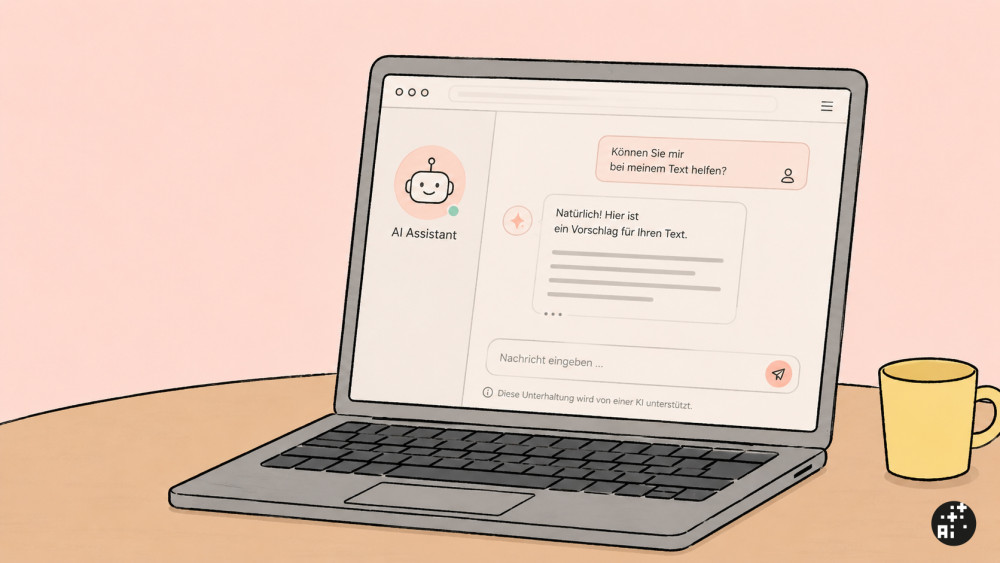
Labelling is also required in situations where users interact directly with AI, for example with a chatbot on a website, via telephone-based voice systems in customer service, or in automatically generated reply emails.
Article 50(1) of the AI Regulation stipulates that providers must carry out this labelling. ‘Providers’ within the meaning of the Regulation are natural or legal persons, public authorities, bodies or other entities that develop AI systems or models, or have them developed, and place them on the market or put them into service under their own name or trade mark.
As a commentator, you should therefore always consider adding such a label whenever you set up AI-based interactions for your own company or for your clients.
How to label AI texts and interactions correctly
In the first part of our series of articles, we’ve already provided examples of how to correctly label AI-generated or AI-edited image, video or audio content. Here are our recommendations for AI texts and interactions.
For text:
This text was created with the assistance of AI.
Text created with the assistance of AI.
This content was created using artificial intelligence.
For interactions:
You are chatting with an AI assistant.
This chat is powered by artificial intelligence.
You are speaking to an AI-powered assistant.
What are the practical consequences of a lack of AI labelling?
In practice, the failure to label AI content could soon be seen as more than just a minor offence. The Regulation stipulates that such infringements may be punished with fines of up to 15 million euros or 3 per cent of the operator’s global annual turnover (Articles 99–101 of the AI Regulation).
In practice, actual fines are unlikely to reach the upper limits of this range. Nevertheless, they can have a significant financial impact on the organisations or agencies concerned.
Another risk: competition law issues. For instance, in the absence of AI disclosures, competitors and consumer protection organisations may in future bring legal action for breaches of the Unfair Competition Act (UWG).
Does old AI content need to be labelled retrospectively?
In many sectors, such as PR and marketing, communication content such as images, videos, audio files and text is often produced well in advance of its publication. This currently raises the practical question of whether AI content produced and published before 2 August 2026 must now be labelled retrospectively.
The AI Regulation itself does not provide a definitive answer to this, for example in the form of a transitional provision. However, the European Commission published relevant guidelines in July 2026. Whilst these are not legally binding, they do carry some weight. According to these guidelines, content that was generated or manipulated using AI before 2 August 2026 does not, in principle, need to be labelled retrospectively. The Commission does, however, encourage those affected to apply such labels on a voluntary basis, thereby contributing to greater transparency.
Did you enjoy this blog post? If so, you might also be interested in this:


Benedict Rehbein
Benedict Rehbein is the founder and managing director of PIO, the PR agency that asks. With the slogan “What matters?”, PIO communicates what really counts for its clients. Benedict has received awards such as the German PR Report Award for his work.
Hero Picture: Fabrizio Matarese / https://betterimagesofai.org / https://creativecommons.org/licenses/by/4.0/