
AI Regulation and AI Labelling Requirements Part I: Images, Videos and Audio
The labelling requirements under the European AI Regulation have been in force since August 2026. In Part I of our series of articles on this topic, we explain what this means for AI-generated images, videos and audio files – including some helpful examples.
Disclaimer: The information provided on this website does not constitute legal advice and is not intended to address any legal issues or problems that may arise in individual cases. The information on this website is of a general nature and is provided for information purposes only. If you require legal advice regarding your specific situation, you should seek the advice of a qualified lawyer.
European AI Regulation and AI labelling requirements
Since 2 August 2026, the labelling requirements of the European AI Regulation (AI Reg) have been in force in Germany. They apply to content created or modified by AI, as well as to instances where users interact with AI. As a professional communicator, this is relevant to you, as the use of generative AI has long been the norm in marketing departments and agencies.
But what exactly does the Regulation change? In our series of articles, we explain who is subject to the labelling requirement, when it applies and what the consequences of non-compliance are. We also provide helpful practical examples and offer simple templates for labelling your AI content. Part I focuses on the following questions:
Who is required to label content?
When and how must AI images, videos and audio content be labelled?
Which AI images, videos and audio files do not need to be labelled?
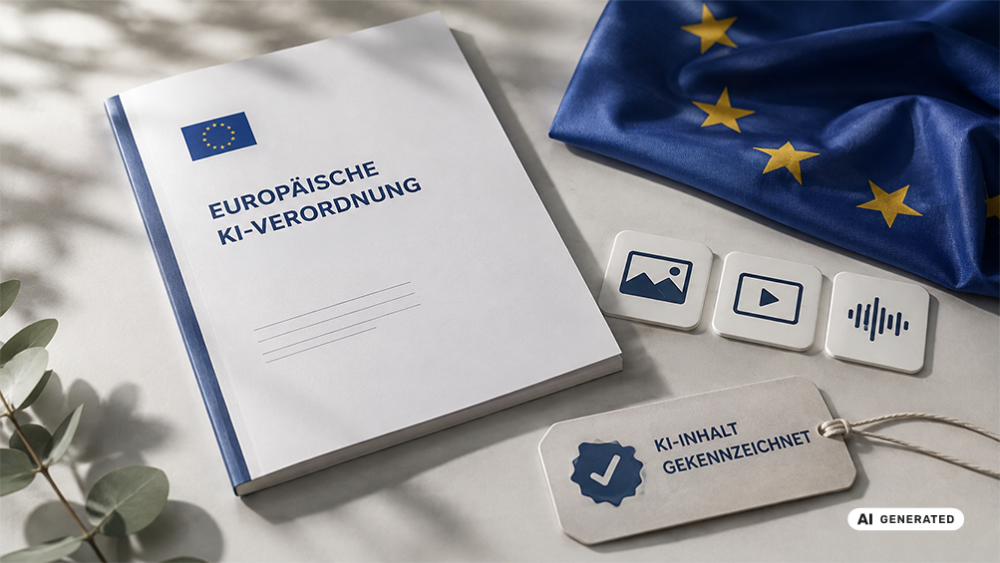
Who is required to label AI content?
According to the Regulation, the obligation to label AI content lies with the ‘operators’. These are all natural or legal persons, public authorities, institutions or other bodies that use AI systems on their own responsibility (AI Regulation, Article 3(4)). The only exception is where the use takes place in a personal context outside the scope of professional activity.
For you as a communicator, this means:
As soon as you share AI-generated content not privately (e.g. amongst friends) but, for example, in a professional LinkedIn post via a company account, your actions are subject to the labelling requirement.
It is irrelevant whether you yourself are ‘merely’ a user – that is, someone using one of the commercial tools such as ChatGPT or Midjourney. You are the ‘operator’ – not the developers, such as OpenAI or Anthropic.

What are ‘deepfakes’ subject to labelling requirements?
Images, videos and audio clips created or edited using AI fall under the term ‘deepfake’ in the regulation. However, the regulation defines this term differently from how we use it in everyday language.
In colloquial terms, ‘deepfake’ often refers to a manipulated image or video of real people, created deliberately to deceive the public and cause harm to those depicted – for example, by making the people in a video appear to be doing something illegal or problematic, thereby causing them real negative consequences.
The AI Regulation (Article 3(60)) provides a broader definition of the term ‘deepfake’.
It states:
Deepfakes also include depictions of objects, places, facilities or events – not just of people.
There is no need for an intention to deceive for something to be classified as a deepfake. It is sufficient that the content appears real (i.e. photorealistic in the case of images and videos) and could be mistaken for the real thing by the average viewer.
It does not matter whether the depicted content actually exists. Therefore, the labelling requirement applies not only to depictions of real people such as Brad Pitt, for example. Fictional characters also count as deepfakes, provided they are depicted realistically.
Which AI-generated images, videos and audio recordings do not need to be labelled?
Minor post-production edits to images, videos or audio – such as colour and lighting corrections or the retouching of skin imperfections – are exempt from the labelling requirement. Similarly, content that is obviously fictional – such as material with a distinct ‘cartoon’ or animated style – does not need to be labelled.
Tip: As a rule of thumb, remember this: if an AI-generated image, video or audio clip suggests a ‘real’ recording situation that never actually took place, it must be labelled accordingly.
Practical examples – What to expect in day-to-day PR and marketing
What constitutes a deepfake requiring labelling in a PR and marketing context is not always clear at first glance in practice. In the following case studies, we therefore demonstrate when you should label AI-generated images, videos and audio in your day-to-day work going forward.
Case study 1: Fully generated images and videos
The scenario: As part of an advertising campaign for a peppermint chewing gum, you use a prompt to generate a series of photorealistic images of people chewing the gum in various everyday situations (at the office, with family, on a date, etc.).
The result: The people and places depicted do not exist, but they look as though they were captured during a real photo shoot. In principle, you can therefore assume that, in such cases, you will regularly need to label the images as AI-generated.

Case study 2: AI influencers using ‘user-generated content’
The situation: For your peppermint chewing gum campaign, you’re setting up a social media profile for a completely fictional influencer. Using AI, you create a video showing him giving the chewing gum a positive review, as if he’d tried it himself. The video mimics the look of a self-filmed mobile phone video and appears to have been recorded in the influencer’s own home.
The result: Visually and aurally, the video gives the impression that a real person is sharing their opinion based on personal experience. Therefore, in this and similar cases, you can generally assume that a disclosure requirement applies.

Case Study 3: Voiceovers and AI Audio
The situation: You’re filming a commercial with real actors for your peppermint chewing gum campaign. After filming, you use AI to add a voice-over to the advert, which promotes the chewing gum. The voice imitates human intonations, emotions and pauses for breath with remarkable realism.
The result: Even though the video footage used is authentic, the voiceover suggests that a human speaker recorded it in a real recording situation. That is why, in this and similar cases, you may need to consider a potential labelling requirement.

Case Study 4: Photorealistic product images
The situation: As part of your peppermint chewing gum campaign, you are creating an image of a coffee-machine-sized chewing gum vending machine for the home. The machine is a completely new concept and does not yet physically exist. You then render the AI-generated machine into a photorealistic image set in a stylish flat in a period building.
The result: The final image focuses on a product that does not actually exist (yet), but may give viewers the impression that it is real. You should therefore check whether there is a requirement to label it as such.

Are you looking for the right partner to help you integrate AI into your organisation? We’d be delighted to support you and your business with our AI services.
Labelling images, videos and audio files correctly
Under the Regulation, you must provide AI labelling in a ‘clear and unambiguous manner’ and in an accessible format (Article 50(5) of the AI Regulation). The labelling should therefore be brief and concise and should not contain any misleading wording. It should also stand out visually from the rest of the content and be accessible, for example, to people with visual or hearing impairments. A barely recognisable note ‘in the small print’ is therefore not sufficient. Below you will find our recommendations for suitable wording that you can use to label AI-generated images, videos and audio content in your communication materials:
For images:
Image created using AI
AI-generated image
AI GENERATED
For videos:
Video generated by AI
For audio content:
Audio created using AI
Artificially generated voice
In the next part of our series on the AI Regulation and the AI labelling requirement, we’ll take a closer look at the regulations you need to observe when dealing with AI-generated text and interactions, and the potential consequences for you of breaching the AI Regulation.
Did you enjoy this blog post? Then you might also be interested in:


Benedict Rehbein
Benedict Rehbein is the founder and managing director of PIO, the PR agency that asks. With the slogan “What matters?”, PIO communicates what really counts for its clients. Benedict has received awards such as the German PR Report Award for his work.
Featured image: Max Gruber / Better Images of AI / CC BY 4.0 / Cropped and edited